
 RENT AN INSTRUMENT
Original receipts, certificates, past valuations or appraisals
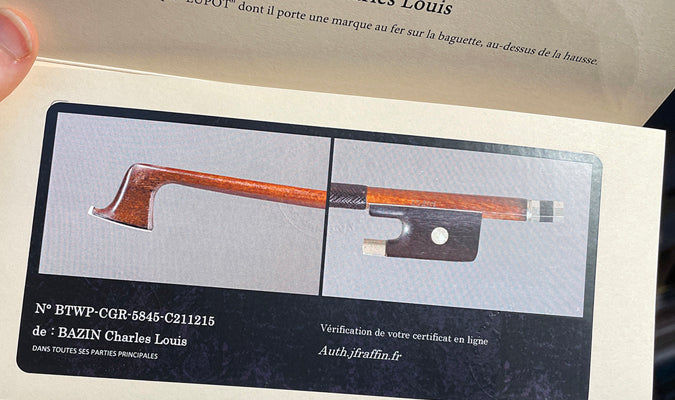
If you have the original receipt of purchase, any past valuations or a certificate verifying the authenticity of your instrument or bow, please include a digital copy in your submission.
It is always necessary for us to see the instrument or bow being valued in person, however as a first step, we ask you to send through any relevant documentation and pictures of your instrument or bow via our online form. This will give us an idea of what to expect and whether or not the instrument is worth being valued for insurance. After we receive your submission we will be in touch as soon as possible to book an appointment.
If you have the original receipt of purchase, any past valuations or a certificate verifying the authenticity of your instrument or bow, please include a digital copy in your submission.

For instruments, please provide clear pictures of the front, back and side of the scroll, against a plain background. Photos taken on your phone are perfectly fine as long as they are in focus. Please do not include the case. We only need photos of the instrument.
Please also include a picture of the makers label. If your instrument has a label, it will be on the inside of the instrument, which can be seen when you look through the F-holes.
When photographing labels, we recommend using the wide angle lens on an iPhone and placing the instrument under a bright light. If you are unable to take a clear photograph, please provide us with written details of the text on the label.
For bows, please provide pictures of the frog and the tip. Photos taken on your phone are perfectly fine as long as they are in focus. For best results we recommend taking you images under natural window light against a plain background. We may require extra images that involve removing the frog of the bow however, please do not attempt to do this without verbal instruction over the phone.

An insurance valuation is a professional assessment that determines the replacement cost of an item for insurance purposes. The goal of an insurance valuation is to ensure an instrument is adequately insured should it be damaged beyond economical repair, lost or stolen, preventing its owner from facing significant out-of-pocket expenses
An insurance valuation is a statement in writing of the opinion of the instrument’s value for replacement. A certificate of authenticity gives the expert’s opinion as to the provenance of the instrument.
If your bow is in the advanced-professional range, it would be worthwhile considering obtaining an insurance valuation for it. You may be able to obtain a joint valuation with your instrument.
Musical instrument insurance typically covers accidental damage, loss and theft, along with worldwide coverage and protection while in transit. Some policies include benefits like emergency hire costs for replacement instruments.
Updating your insurance valuation every 3-5 years is important to ensure you are covered for its current replacement value.
Your homeowner’s policy might cover your instrument, but its coverage may not be adequate. Some policies also exclude commercial use so you may need a specialised policy if you use your instrument professionally.
Yes. Some examples are EBM, Marsh and Action Insurance . You would likely use one of these if you want more bespoke coverage, particularly if you play professionally and/or travel frequently with your instrument.
An insurance valuation determines the cost to replace a damaged instrument with one of similar quality, and is usually higher than the instrument’s market value.
We have endeavoured to offer verbal and informal selling valuations in the past, however, due to the litigious nature of today’s society, we are no longer able to offer this service.
We are always on the lookout for exceptional instruments and bows to add to our professional ranges. However, we have strict criteria for items that can be sold on consignment with us. Please see our Consignments & Acquisitions page for more information.
Check the label on the inside of the violin through the f-hole, as there are many resources online which can help (this is particularly the case for modern violin brands like Stentor, Gliga, Raggetti, Enrico, Suzuki, Paganini etc)
The Stradivarius model is the most widely copied violin design in history, so instruments with a “Strad” label are almost never by the original maker. A useful indicator of whether a violin could be from the late 17th or early 18th century is the internal label—modern printing or fonts are a clear sign of a later reproduction. Nearly all known Stradivarius instruments have been thoroughly documented and accounted for, making the discovery of an unknown original extremely unlikely.
We may be able to offer probate valuation services. Please make an appointment using the form below/above, with any photos and documentation attached.
We collaborate with many international experts and can help assist you in having your instrument certified. Certification must be carried out in person, so this would either involve sending your instrument abroad, or booking a space for it on one of our annual international visits.
For owners of modern instruments, our advice would be to reach out to the maker directly to obtain certification.
If your instrument is of Australian-made origin—such as those crafted by A. E. Smith, Kitty Smith, Cedric Clarke, Harry Vatiliotis or similar makers—we have the expertise and historical knowledge to certify these instruments internally. In these cases, we can issue a certificate ourselves at a fee of $500.
The Sydney String Centre sits on the unceded lands of the Gamaragal people. We pay our respects to Elders and communities past, present, and emerging. We celebrate the stories, culture and traditions of Aboriginal and Torres Strait Islander people who also work and live on this land.